
The latest Strathbungo newsletter includes the curious discovery that Q, James Bond’s favourite quartermaster, was actually a former Strathbungo resident. The story comes courtesy of the Herald, and the sharp eyes of local resident David Cook.
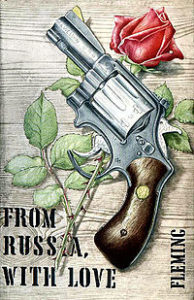
Imagine the curtains twitching back in 1956 when the CID called at 17 Regent Park Square. They wanted to question the licence-holder of a revolver matching the gun used by one of Scotland’s most notorious serial killers. Geoffrey Boothroyd, a young technical rep at ICI, told them that his gun was actually down south being illustrated for the cover of Ian Fleming’s next James Bond novel, From Russia with Love.
That old excuse…
And it was true. Boothroyd, a gun collector, had written to Fleming earlier that year to say that Bond’s .25 Beretta was “really a lady’s gun”. He suggested instead a manly Smith & Wesson .38. Little did he know that it was also the weapon of choice for one Peter Manuel, then on a murderous spree that would claim seven lives, the last three in Burnside.
The detectives eventually got their man and Manuel got justice at the end of a rope. Boothroyd and Fleming continued their friendly correspondence. At the end of From Russia with Love, Rosa Klebb managed to stab Bond with her famous boot, partly because his Beretta got caught in his holster.
In his next novel, Dr No, Fleming included a whole chapter in which Bond was introduced by M to the armourer, Major Boothroyd. He confiscated Bond’s Beretta – “Ladies’ gun, sir” – for a Walther PPK, with the Smith & Wesson Centennial Airweight .38 revolver as back up. A new holster was also recommended, and all was based closely on Geoffrey Boothroyd’s advice. Daniel Craig still uses the Walther PPK to this day.
Oddly the character Q never appeared in Fleming’s novels; he only referred to Q Branch, suppliers of gadgets. Major Boothroyd appeared just the once, and it wasn’t clear he was from Q Branch either.
Boothroyd himself became firearms consultant for Dr No, the first Bond movie, and also advised on such matters as how to set an ocean on fire – no doubt his work at ICI came in handy. Peter Dawson played Major Boothroyd in the movie version of the above scene from Dr No.
It was only in the second movie, From Russia with Love, that Major Boothroyd also became known as Q, and was played famously by Desmond Llewellyn, in that movie and for the subsequent 36 years.
Geoffrey Boothroyd was quite an eccentric who once told Fleming: “I cherish a dream that one day a large tiger or lion will escape from the zoo or a travelling circus and I can bag it in Argyll Street.” That never happened, but he went on to become one of the world’s leading authorities on shotguns and handguns.
The Herald, October 2015: The article that prompted this story
Letters of Note: Fleming’s reply to Boothroyd’s original letter, addressed to 17 Regent Park Square
The Guns of James Bond – BBC Archive: Mr Boothroyd himself, in a 1964 short presented by Sean Connery, explaining his reasoning behind his choice of weapons. The film appears to have been shot inside his Strathbungo home; although by this time he had moved from 17 to 11 Regent Park Square, where he lived from 1956 to 1971. A recent resident of No 11 recalls his parents purchasing the house from the Boothroyds, and remembers the house being full of weapons, including a Gatling gun in the living room. Does the current resident recognise it?
I am slowly amassing a history of Strathbungo, including stories of former residents of note such as this. If you have any stories to tell, or wish to know more about your own home, please get in touch. One day I hope it will all make it onto the blog.
(Updated 14/3/2016)

Recent Comments